


Porcelain Slabs also called sintered stone
The look of marble and stone in one giant slab, up to 64 x 127 in. It handles heat, sun and spills, and never needs sealing.
Shown: Oro Noir bookmatch feature wall
Where it goes
Real rooms. One continuous slab look where tile would need dozens of grout lines.
 Fireplace and feature walls6 mm · Shown: Gemma Bronze ›
 Vanity tops12 mm · Shown: Calacatta Noir ›
 Islands and vanity blocks with mitred edges12 mm · Shown: Bianco Gioia ›
 Bathroom and shower walls6 mm · Shown: Bianco Dior ›
 Floor, walls and counter in one look6 + 12 mm · Shown: Verdi Alpi ›
 Statement wall behind a tub6 mm · Shown: Calacatta Noir ›

Bookmatch
Two slabs, one mirror image
Bookmatch slabs are cut one after another from the same block, so the veins mirror each other like an open book. Put two side by side and you get a single, symmetrical pattern for a fireplace or feature wall.
Tip: order bookmatch slabs in pairs from the same block number (it is in the product name, e.g. "Block 36"). Call us and we'll confirm the pair is in stock.
Shop bookmatch slabs ›6 mm or 12 mm?
Same look, two jobs. Pick by what the slab has to do.

6 mm about 1/4 in
For walls
- Feature walls, fireplace surrounds, shower and bathroom walls, cladding
- Light: about 165 lb for a 63 x 126 in slab
- Delicate to cut: needs full support while cutting
- On a countertop only when glued to a full, flat base

12 mm about 1/2 in
For countertops
- Kitchen counters, islands, vanity tops, furniture
- Thick enough for mitred edges that look like a thick stone top
- Overhang up to about 6 in without support; 6 to 12 in with a support
- About 331 lb per 64 x 127 in slab
Popular slabs
 63 x 126 in Majesto Gemma Bronze Block 45 Bookmatch Cut Honed Rectified6 mm (1/4 in) · walls$1,199 / slab
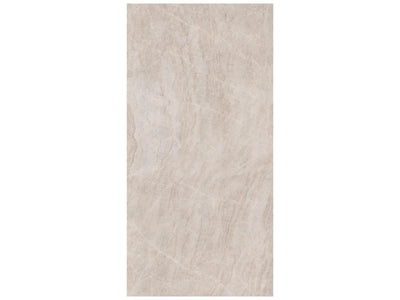 64 x 127 in Majesto Taj Mahal Block 36 Bookmatch Cut Honed12 mm (1/2 in) · countertops$2,400 / slab
 63 x 126 in Majesto Taj Mahal Honed Rectified6 mm (1/4 in) · walls$1,199 / slab
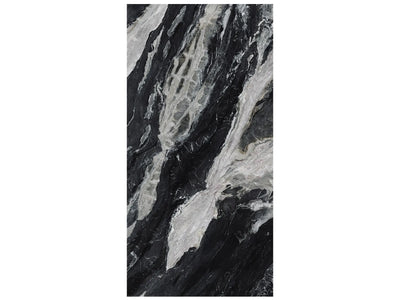 63 x 126 in Majesto Bianco Dior Block 38 Bookmatch Cut Honed Rectified6 mm (1/4 in) · walls$1,199 / slab
 63 x 126 in Majesto Calacatta Picasso Block 32 Bookmatch Cut Honed Rectified6 mm (1/4 in) · walls$1,199 / slab
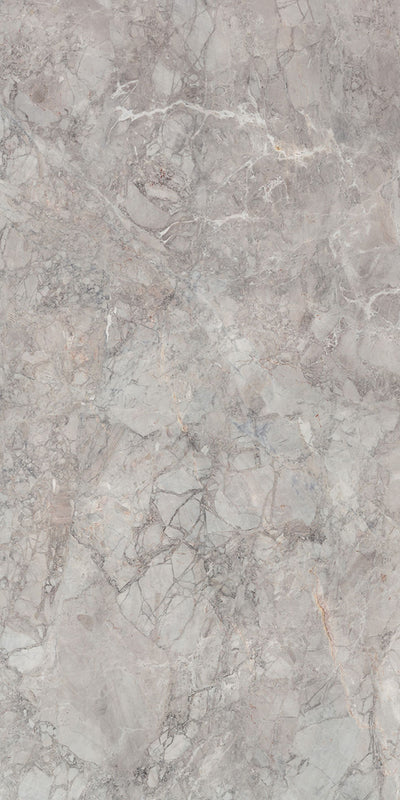 64 x 127 in Majesto Marina White Block 46 Bookmatch Cut Honed12 mm (1/2 in) · countertops$2,401.14 / slab
 64 x 127 in Majesto Bianco Gioia Block 19 Bookmatch Cut Polished12 mm (1/2 in) · countertops$2,400 / slab
 64 x 127 in Majesto Calacatta Cremo Block 31 Bookmatch Cut Polished12 mm (1/2 in) · countertops$2,401.14 / slab
Porcelain slab vs quartz
The countertop most people compare it with.
Natural stone: granite needs resealing about every 2 to 3 years, and marble etches from lemon juice and wine. Porcelain slabs need neither.
See the full comparison (quartzite, porcelain tile, solid surface, laminate)
| Porcelain slab | Quartz | Granite | Marble | Quartzite | |
|---|---|---|---|---|---|
| What it is | Fired natural minerals, no resin | Up to 90% quartz plus pigment and resin | Natural stone, mostly silicate minerals | Natural stone, mostly calcite | Natural stone, almost all quartz |
| Stains and sealing | Absorbs under 0.08%; no sealing | Non-porous; no sealer | Seal; reseal about every 2 to 3 years | Sealing recommended; acids etch it | Sealing recommended |
| Acid (lemon, wine) | Chemical resistance Class A | — | Resists acid | Etches | True quartzite does not etch |
| Outdoors | Facades and outdoor kitchens; frost resistant | Resin changes color in UV | — | Acid rain weathers it | — |
Solid surface handles heat up to about 175°F and laminate up to about 275°F for short periods; neither is for outdoor use. A dash means we found no source we trust, so we left it blank.
Colorsync, by Anatolia
Edges that look finished
Easy to live with
For your fabricator and installer
Anatolia's rules, in short. Share this page with your fabricator. Want the full fabrication manual? Call 502-325-0000.

Cutting
- Use a fabricator with real large-format slab experience. Bridge saw, CNC, waterjet or a combined machine all work.
- Wet cut with diamond tools made for sintered slab, not discs used on quartz or stone. Dry cutting is not recommended.
- Flat, clean, level bench. 6 mm slabs need a support pad under the full length.
- Slow to half speed for the first and last 8 in of each cut.
- Bookmatch: plan the cuts so the pattern lines up across the seam.
Cut-outs and corners

- No square inside corners. Drill the corners first (radius usually 10 mm, never less than the slab thickness), then cut between them.
- Keep sink and cooktop cut-outs about 3 in (7 cm) or more from the edge and about 4 in (10 cm) from each other.
- Leave about 1.5 mm around flush-mount sinks and cooktops.
- No 45° joints on L-shaped tops and no 45° inside edge at the sink: use straight joints.
Support, overhangs and gaps
- The slab is a covering, not a structure: cabinets or a frame carry the load. Keep cabinets level and stable.
- 12 mm on a full support or on reinforcements; 6 mm countertops always on a full, flat support. Never glue onto quartz strips.
- Overhang up to about 6 in (15 cm) without support; 6 to 12 in (15 to 30 cm) with a support; longer runs need a support at least every 24 in (60 cm).
- Holes 6 to 24 in from the edge: halve the overhang. No overhang with an opening closer than 6 in to the cabinet edge.
- Leave 3 mm (1/8 in) at walls and 2 mm at seams.
Gluing and seams
- Built-up edges: two-part epoxy or polyurethane in the slab's color; grind a 1/16 in chamfer after it sets.
- Glue the top to the cabinets, or two pieces together, with an elastic, clear adhesive such as silicone.
- Wet cut, use dust control and wear a respirator: cutting makes silica dust.
Questions people ask
Will the edges chip?
They can. A porcelain slab is hard, but a sharp knock can chip an edge or corner. That is why every edge gets at least a small chamfer or round, and a rounded edge where knocks are likely. Choose 12 mm for kitchen edges and mitred fronts.
Does the pattern run through the slab?
No. The veins are on the face. With Colorsync the body is blended to a matching color, so cut and mitred edges look finished, but the veins don't continue into the edge. A few unglazed, solid-color slabs are the same color all the way through.
Can I put a hot pan on it?
It is rated heat resistant and passes thermal shock tests. Anatolia doesn't publish a maximum temperature, so we suggest a trivet, a good habit on any counter.
Can it go outdoors? Will it fade?
Yes. It is frost resistant, Anatolia lists it for facades and outdoor kitchens, and its warranty covers fading from the sun, indoors and out.
Does it stain? Does it need sealing?
It absorbs less than 0.08% water and scores Class A for stain resistance. It never needs sealing. Wipe spills quickly.
Can it be repaired?
Light scratches can often be worked out. Deep scratches are difficult or impossible to repair, and there is no published chip repair method, so ask your fabricator before you buy.
Will I see the seams?
Our slabs are up to 64 x 127 in, so many tops need few seams or none. Bookmatch slabs mirror the veins across a seam; small shifts in the pattern can still show.
What warranty does it have?
Anatolia's warranty covers its published specs for the life of the original owner in a home, and 10 years for commercial use, on its terms. Damage from impact and a sample-to-slab difference are not covered.
See it before you buy
A sample chip of the exact slab, $12.99
A piece of that slab design in the same finish and thickness: about 4 x 5 in for 6 mm and about 9 x 12 in for 12 mm. Use the Add sample chip button on any slab page.
Slabs ship by freight on an A-frame; online, one shipping charge covers it. Slabs in stock in Louisville can be picked up at 2900 Fern Valley Rd, Louisville, KY 40213.